


Views: 0 Author: Site Editor Publish Time: 2026-05-12 Origin: Site


Modern HVAC hydronic systems cannot afford performance degradation. Facility managers and engineers invest heavily in high-efficiency chillers, condensing boilers, and variable frequency drives. Yet, these networks frequently suffer from entrapped air, fluctuating static pressure, and resulting energy penalties. Traditional pressure maintenance methods rely on bulky rooftop tanks or standalone manual make-up valves. These setups consume excessive mechanical room space and fail to remove dissolved oxygen. This failure causes aerobic corrosion, erratic pump behavior, and premature equipment degradation. Passive air separation fails to protect complex commercial loops. The modern standard for resolving these operational bottlenecks is the Automatic degassing constant pressure water refill device. This equipment manages system volume, removes corrosive gases, and stabilizes static pressure. This guide explains the engineering principles, technical specifications, and sizing criteria required to evaluate these systems for large-scale hydronic loops.
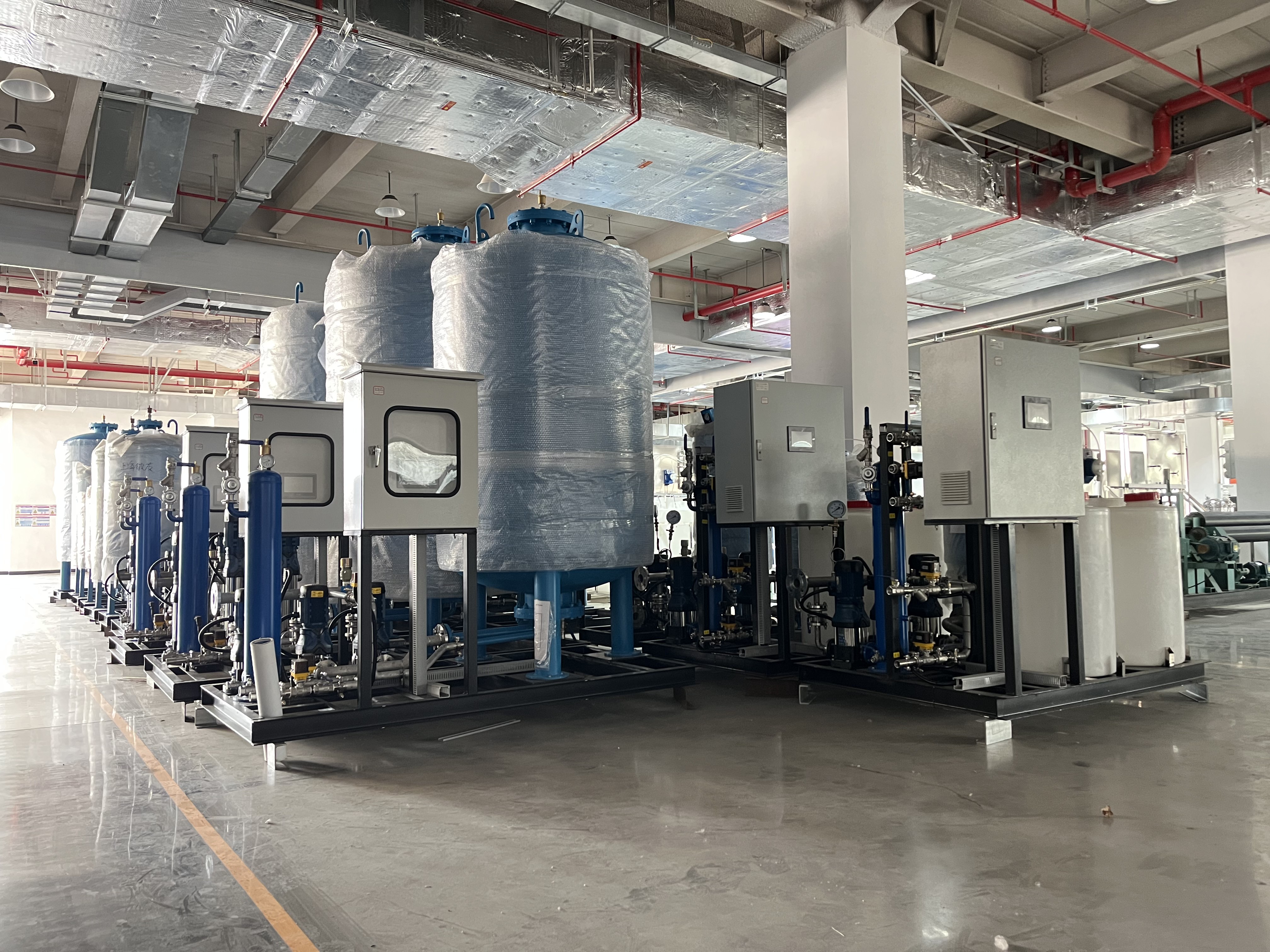
Capex & Space Efficiency: Eliminates the need for traditional rooftop water towers and oversized expansion tanks, reducing the mechanical room footprint and initial capital investment by 40% to 60%.
Complete Deaeration & Rapid Commissioning: Utilizes vacuum technology to achieve >99% removal of dissolved and free gases. This effectively halts aerobic corrosion of ferrous piping and drastically shortens the initial water filling and exhaust commissioning time.
Micro-Precision Control: Maintains system pressure to a tolerance of ±0.01Mpa (±0.01bar)—up to 10x more accurate than legacy bladder tanks and mechanical PRVs.
Smart Facility Integration: Ships ready for Building Management System (BMS) integration via BACnet/Modbus, providing real-time telemetry on system pressure, pump status, and make-up water volume.
Air exists in hydronic systems in three forms: free air, entrained bubbles, and dissolved gases. When free air accumulates at the highest physical peaks of a piping network, it creates a physical obstruction. This air block restricts water circulation and can completely stop flow in severe cases. You will notice thermal dead zones where terminal units receive zero heating or cooling. Circulating pumps attempt to push through this compressible air cushion, wasting energy while producing zero functional fluid movement.
Henry's Law of gas solubility dictates that water holds less dissolved gas as its temperature rises. As water passes through a boiler heat exchanger, dissolved oxygen and nitrogen precipitate out of solution, forming micro-bubbles. Conversely, as water chills in a cooling circuit, it absorbs gas. This constant shifting of gas states means passive separation is never completely effective.
Beyond physical blockages, dissolved oxygen initiates chemical degradation. Aerobic corrosion actively attacks ferrous materials throughout the loop. Steel pipes, cast iron pump volutes, and boiler heat exchangers oxidize, generating black iron oxide sludge known as magnetite. This highly abrasive sludge destroys mechanical seals, clogs fine-mesh strainers, and coats heat exchange surfaces. The thermal penalty is measurable. Dissolved air and magnetite scale reduce the heat transfer properties of water. Chillers and boilers work harder, consuming excess electricity and natural gas to meet baseline load demands.
A protected system requires a holistic engineering approach rather than isolated fixes. Effective air management relies on four coordinated components working in sequence. You must install and calibrate these components together for optimal fluid stability.
High-Capacity Automatic Air Vents: Position these at all system peaks. They expel large, free-floating air pockets during the initial fill and commissioning phase.
Inline Air Separator: Install this at the lowest pressure point of the system, typically just upstream of the primary pump suction. This handles entrained bubbles before they enter the pump impeller.
Calibrated Make-Up Water Assembly: Connect this to the municipal water supply to replace volume lost to minor leaks or thermal contraction.
Master Pressure Reducing Valve (PRV): Govern the incoming water line with this valve. The PRV guarantees the vertical column of the building maintains positive static pressure, preventing external atmospheric air from entering through pipe joints.
Consider a field scenario in a three-story educational facility. During peak summer loads, the Air Handling Units (AHUs) on the top floor become starved for chilled water flow. Down in the mechanical room, the Variable Frequency Drives (VFDs) controlling the main circulation pumps begin to oscillate rapidly. This condition is known as "hunting." The system constantly speeds up and slows down, trying to satisfy a differential pressure setpoint that it cannot physically reach.
Contractors often misdiagnose this issue. They manually override the VFD to strictly increase pump speed, attempting to force water up to the roof. This approach wastes electricity, adds zero functional head pressure, and pushes the pumps into severe cavitation. The water cannot reach the upper AHU coils due to a lack of baseline static head.
The root cause traces back to the mechanical room. An incorrectly set PRV on the make-up water assembly fails to provide baseline pressure. If the PRV is set too low, the system lacks the foundational static pressure to push water up the vertical riser. Once you calculate and adjust the static pressure correctly, the VFDs stabilize immediately, and top-floor flow returns.
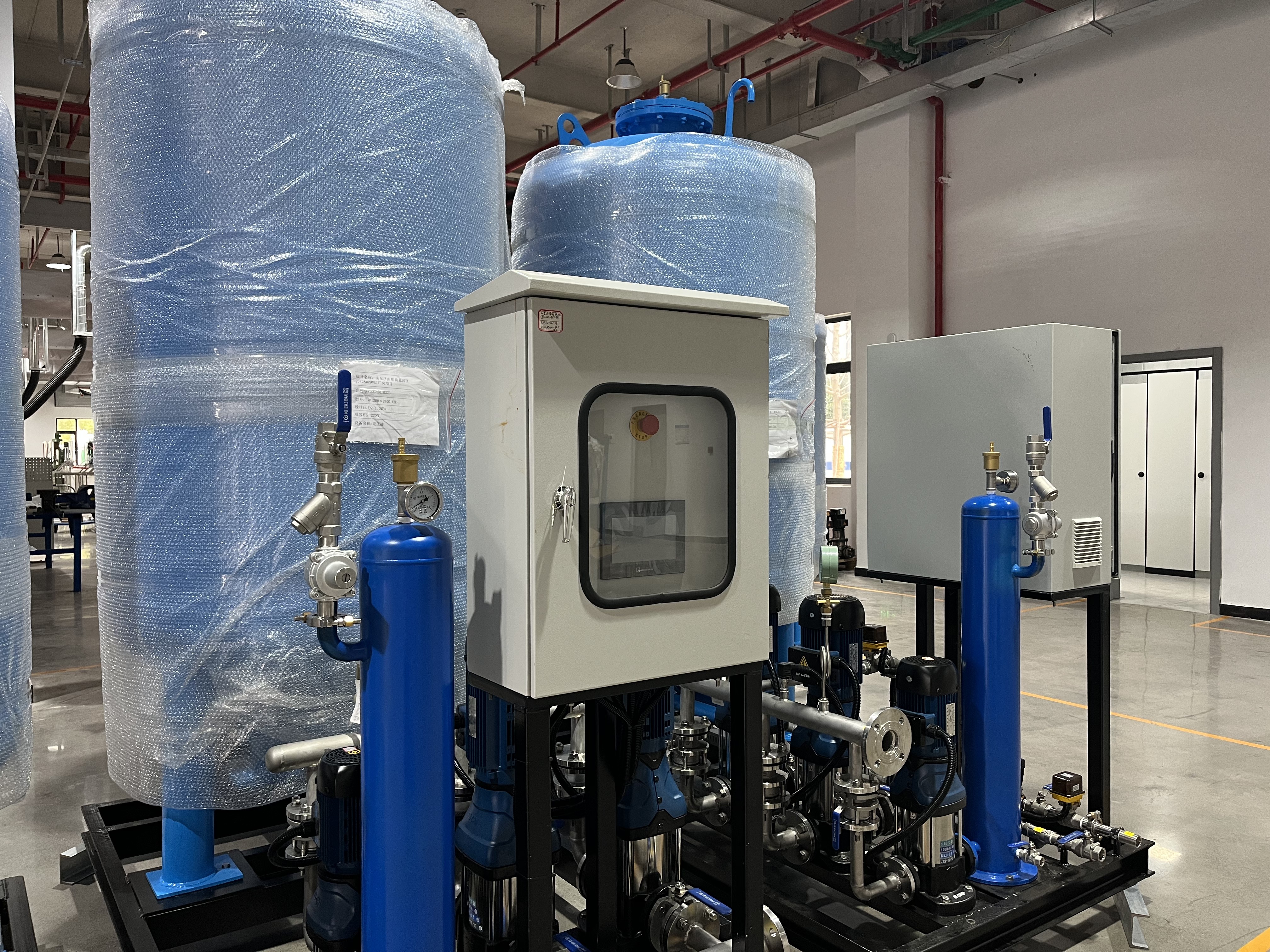
Modern pressure maintenance relies on a tightly integrated skid. Understanding the individual components helps facility engineers evaluate build quality, specify parts, and plan maintenance schedules.
| Component | Material & Construction Specs | Primary Function in Hydronic Loop |
Control System | PLC-driven interface, IP54-rated enclosures, variable frequency regulation. Supports Modbus/BACnet. | Monitors real-time pressure transducers and automates pump staging and degassing cycles. Delivers telemetry data directly to the BMS. |
Expansion Tank | Q345R and 20# carbon steel shell. Heavy-duty butyl rubber diaphragm. Built to GB150, TSG 21-2016, or ASME standards. | Separates system water from the compressed air cushion. Absorbs thermal expansion volume to prevent system over-pressurization. Offers a 10-year design life. |
Water Pump | Industrial-grade centrifugal pumps. Ultra-low noise operation (≤ 65 dB). | Injects make-up water precisely when system static pressure drops below the PLC-defined threshold. Drives fluid through the primary degassing cycle. |
Degassing Tank | 304 stainless steel standard. 316L food-grade upgrades available for highly corrosive environments. | Utilizes physical vacuum pressure differentials to pull water into a low-pressure state, extracting deeply dissolved micro-bubbles and expelling them. |
The Automatic make-up degassing unit operates on a strictly defined sequence of expansion and compression. The system utilizes static pressure as its initial head. Because water is an incompressible fluid, any rise in system temperature causes thermal expansion. This expanding water pushes against the heavy-duty butyl rubber diaphragm inside the expansion tank. The water chamber expands, compressing the sealed air cushion on the other side. The system pressure rises gently until it hits the upper PLC limit. At this limit, the system triggers the pumps to shut down and standby.
The make-up logic reverses this process. When the system fluid cools down and contracts, the system pressure drops. The compressed air cushion inside the tank expands, forcing water out of the diaphragm and back into the piping network. If the pressure drops down to the minimum safety threshold, the system registers a fluid deficit. The water pump activates. It draws fresh municipal water, passes it through the vacuum degassing tank to strip it of oxygen, and injects it into the closed loop until baseline pressure is restored.
Facility managers rely on a zero pollution guarantee. An Intelligent pressurization degasser operates via a completely physical process. It manipulates pressure and vacuum physics alone. It does not neutralize, oxidize, or interact chemically with existing water treatments, biocides, or glycol mixtures. This guarantees no adverse water quality effects and prevents chemical byproducts.
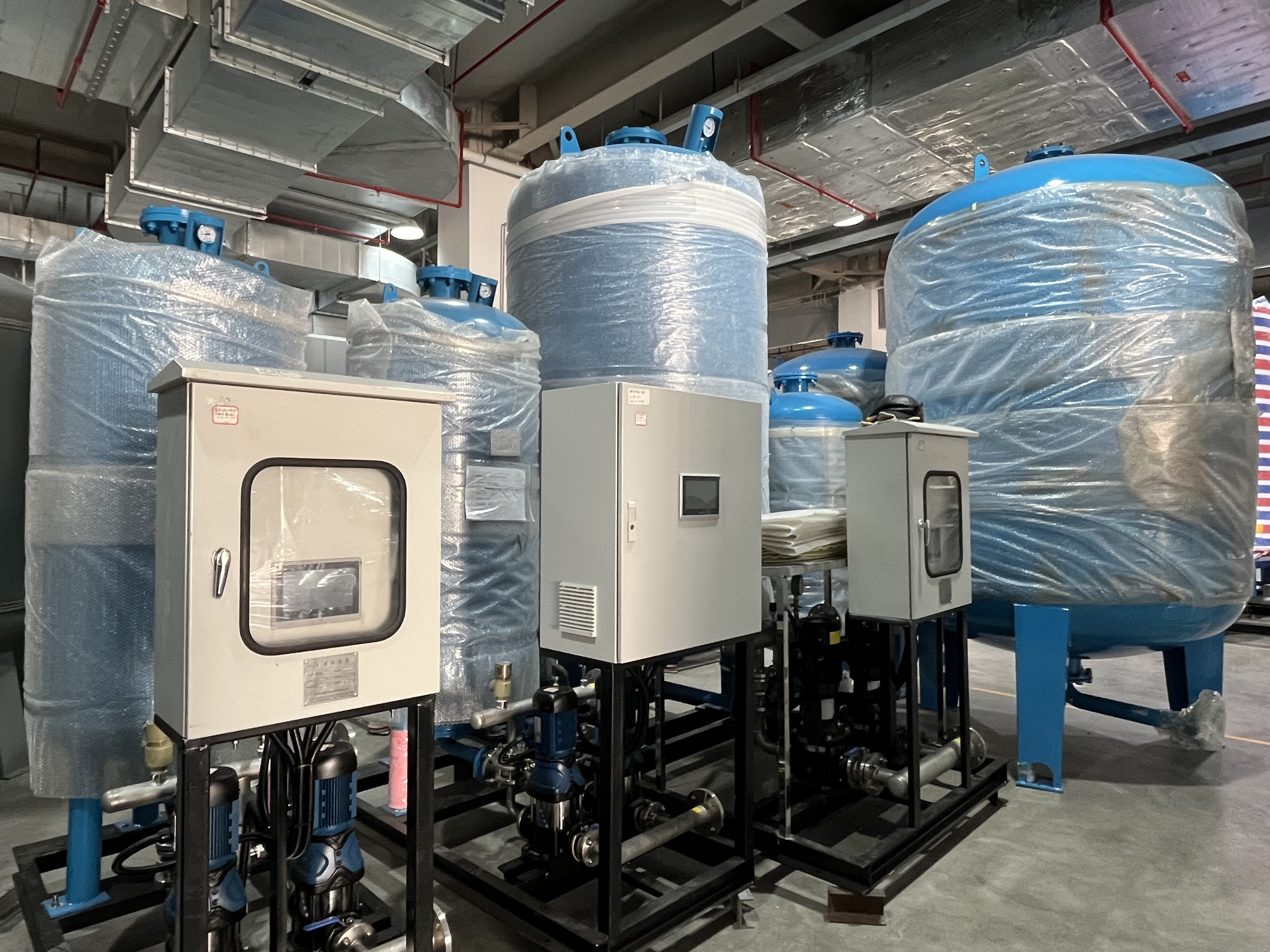
Hydronic architecture dictates the specific type of pressure maintenance required. The Atmospheric Type (CY) fits open cooling water systems. In these environments, the system fluid inherently contacts the atmosphere via cooling tower basins. Atmospheric oxygen ingress happens continuously. However, these systems still require strict volumetric management. The CY unit provides precise level management, foundational pressure control, and basic degassing to handle entrained bubbles before the water hits the primary circulation pumps. It mitigates pump cavitation in large, turbulent open cooling setups.
The Pressurized Type (DY) is mandatory for closed-loop applications. This includes high-temperature boiler systems, primary-secondary chilled water circuits, and low-temperature glycol loops found in industrial factories and large urban commercial complexes. The core benefit of the DY architecture is absolute fluid isolation.
By keeping the water hermetically sealed behind the butyl rubber diaphragm, it stops new gas ingress entirely. Simultaneously, the integrated vacuum cycle strips existing dissolved gases out of the circulating fluid. Over a period of weeks, a Digital constant pressure skid continuously polishes the water. It reduces dissolved oxygen to trace levels and virtually halts internal pipe corrosion.
Navigating manufacturer catalogs requires a clear understanding of equipment model codes. Consider a standard manufacturer designation like ECH-DY-2-100. Breaking this down helps procurement engineers verify specifications against their mechanical schedules.
ECH: Manufacturer or product series identifier.
DY: Type designation. DY indicates a Pressurized closed-loop system. CY indicates an Atmospheric system.
2: Pump configuration. The number 2 stands for a single pump setup. The number 2 indicates a dual-pump redundancy configuration, recommended for mission-critical facilities like hospitals and data centers.
100: Effective tank volume in liters. This dictates how much thermal expansion the system absorbs before triggering pressure relief protocols.
Legacy mechanical pressure reducing valves and standard bladder tanks operate on wide, imprecise deadbands. A mechanical PRV allows pressure to fluctuate by 5 to 10 psi before reacting. This causes system pressure to constantly bounce, leading to unstable flow rates at terminal units. By contrast, a Compact degassing make-up system utilizes highly sensitive electronic pressure transducers governed by the PLC.
This digital oversight delivers a control accuracy of ±0.01Mpa (±0.01bar). This micro-precision is up to ten times more accurate than mechanical methods. It eliminates pump hunting, ensures perfectly stable differential pressure across control valves, and extends the lifespan of pipe fittings by preventing water hammer associated with delayed make-up water injection.
Because these skids connect directly to high-pressure loops, build quality dictates equipment lifespan. Buyers must aggressively verify pressure vessel manufacturing inspection standards. Look for certifications matching GB150, ASME Boiler and Pressure Vessel Code (BPVC), or local equivalents. Ensure flange connections and welding codes meet commercial heavy-duty specifications to guarantee mechanical integrity under repeated thermal stress.
Inspect the wetted parts closely. The internal diaphragm must consist of industrial-grade butyl rubber, which resists permeation and thermal breakdown. The degassing tank itself requires 304 or 316 stainless steel to resist long-term moisture and oxygen exposure. Standard carbon steel components rot from the inside out when exposed to highly oxygenated municipal make-up water.
Mechanical room real estate is expensive. Modern unit designs offer extreme modularity. A high-quality Integrated expansion degassing unit allows the control module and the expansion tank to be separated. They connect via flexible stainless steel corrugated pipes, adapting easily to cramped mechanical rooms, low ceilings, or awkwardly shaped footprints.
Elite systems operate with extremely low inlet pressure requirements. They need incoming make-up water pressure as low as 0.1 Mpa (approximately 14.5 psi). This allows the device to connect directly to standard municipal tap water lines. You avoid purchasing and maintaining secondary booster pump systems, lowering the total cost of ownership and reducing mechanical failure points.
Proper commissioning guarantees long-term stability. Field technicians should follow a strict step-by-step sequence when activating a new pressure maintenance skid.
Verify Mechanical Isolation: Confirm all bypass valves are closed and the expansion tank is securely anchored to the concrete housekeeping pad.
Electrical and BMS Verification: Check phase wiring on the 380V power supply to prevent pump reverse rotation. Ping the PLC via Modbus or BACnet to verify data transmission to the central BMS.
Cold Static Fill: Introduce municipal water slowly. Allow the system to build its initial static base pressure while manually bleeding air from the highest mechanical peaks.
Vacuum Degassing Initiation: Activate the side-stream degassing sequence. Monitor the vacuum chamber pressure gauge to ensure the unit accurately pulls water into a negative pressure state.
Dynamic Pressure Testing: Cycle the main loop pumps on and off. Observe the make-up unit's response time to sudden pressure drops. Verify it holds the ±0.01Mpa tolerance.
Correctly sizing the make-up water pressure is the most critical step in installation. Incorrect static pressure calculations render the most advanced degassing unit useless. The engineering calculation framework for static pressure requires measuring the exact vertical height of the building's hydronic network.
Consider a standard 3-story commercial building with a total vertical hydronic drop of 40 feet from the mechanical room to the highest penthouse AHU. To calculate the required base pressure, divide the height in feet by 2.31. This converts feet of head to pounds per square inch gauge (psig). Water requires 17.3 psig simply to reach a 40-foot vertical height.
Next, you must add a safety buffer at the highest point. A standard 5-psig buffer maintains positive pressure at the system peak. This prevents automatic air vents from sucking in external air when the local booster pumps activate. Add the 17.3 psig base to the 5 psig buffer. The total PRV setpoint requirement for the make-up device is 22.3 psig. You safely round this up to 23 psig.
For a taller 15-story high-rise with a 200-foot vertical drop, the math scales linearly. 200 feet divided by 2.31 equals 86.5 psig. Adding the 5-psig buffer results in a 91.5 psig setpoint. At this pressure, standard 1.0 Mpa (145 psi) expansion tanks operate near their upper limits. You must specify a heavier 1.6 Mpa (232 psi) rated pressure vessel to safely handle the thermal expansion spikes in a high-rise application.
These devices operate under strict environmental and mechanical parameters. Ambient room temperatures must remain strictly between 5℃ and 40℃. Dropping below freezing risks pipe rupture, while exceeding 40℃ overheats the VFD components and PLC logic boards. Install equipment exclusively indoors, shielded from direct sunlight, rain, and corrosive airborne substances.
Standard operating pressures range from 0.1 to 2.5 Mpa, powered by 380V/50Hz industrial electrical supplies. Ensure electrical panels feature phase-loss protection and dedicated grounding.
Maintenance protocols require strict enforcement. Maintenance teams must schedule quarterly routines to clean the Y-strainer on the municipal make-up inlet line. A clogged strainer starves the make-up pump and triggers low-pressure hard lockouts. Technicians must check the PLC interface for historical fault codes monthly. Strictly prohibit the unauthorized disassembly of pressurized pipelines or vessel flanges without first isolating the unit and safely draining the hydraulic pressure. Mishandling high-pressure vessels presents a severe safety risk.
To finalize your facility upgrade, stabilize your hydronic network, and eliminate aerobic corrosion, execute the following actions immediately:
Conduct a physical audit of your current make-up water assembly, identifying erratic pump cycling, weeping mechanical seals, or active pipe corrosion.
Calculate your exact static head requirements by measuring the highest vertical point of your facility's piping network and applying the 2.31 conversion formula.
Map your mechanical room's available floor space to determine if a compact skid or a separated tank configuration fits best.
Consult with a licensed HVAC Professional Engineer (PE) to accurately size the expansion volume and specify the correct vacuum degassing flow rate.
A: Divide the total vertical height of your system in feet by 2.31 to get the base psig, then add a 5-psig safety buffer. This ensures adequate pressure reaches the highest point in the system to prevent air voids.
A: No. It is a strictly physical process that prevents new oxygen-driven corrosion and removes existing gases without creating chemical byproducts. However, chemical inhibitors are still required for comprehensive scale and biological control.
A: Yes. High-quality units have very low inlet pressure thresholds (≥ 0.1 Mpa), allowing them to utilize standard municipal water lines directly without secondary booster pumps.
A: Standard air separators only remove large free-floating bubbles at system high points or pump suctions. Vacuum degassing tanks actively pull water into a low-pressure chamber to force deeply dissolved micro-gases out of solution.
A: When manufactured to GB150 or ASME standards using industrial butyl rubber and Q345R carbon steel, the vessel typically has a 10-year design life, provided ambient conditions remain strictly within 5℃–40℃.
A: No. The unit operates on a bypass or side-stream configuration. It does not interrupt the main hydronic flow, adds zero system resistance, and actively prevents system pump cavitation by ensuring proper baseline static pressure.


